By Pete Stiglich
What a recent ISACA Phoenix discussion—and the audience survey—reveals about the state of enterprise data
Organizations have invested heavily in data warehouses, data lakes, cloud platforms, business intelligence tools, and, increasingly, artificial intelligence. Yet a persistent problem remains: Can business users easily find the right data, understand what it means, and use it consistently?
That question was at the center of my recent presentation to ISACA Phoenix on Semantic Layers and Data Democratization.
A Semantic Layer provides a governed, business-oriented view of enterprise data. It can hide much of the underlying complexity of databases, cloud platforms, APIs, data movement, integration, and differing technologies while presenting data using consistent business terminology, definitions, and rules. The objective is to make enterprise data meaningful and easier to consume without requiring business users to understand where or how the data is physically stored.
But during the presentation, I wanted to understand something beyond the technology itself: How are organizations actually doing today?
We asked the audience several questions. The results provide an interesting snapshot of both the need for Semantic Layers and the considerable distance many organizations still have to travel.
The biggest opportunity isn’t AI. It’s making data understandable.
One of the most revealing questions was: “How would a Semantic Layer most benefit your organization?”
Among the participants, the ranking results translate into approximately:
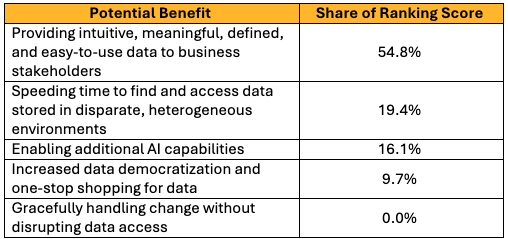
The most important result may be what didn’t come first.
Despite the enormous attention currently being given to generative AI, the audience placed substantially greater emphasis on something much more fundamental: giving business stakeholders intuitive, meaningful, well-defined, easy-to-use data.
That aligns closely with one of the central arguments of the presentation. Semantics is fundamentally about meaning. A Semantic Layer provides meaning to the enterprise’s data language while making that data easier to access.
AI certainly matters. In fact, a Semantic Layer can become an important foundation for AI and Retrieval Augmented Generation (RAG). But AI does not eliminate the underlying problem of inconsistent definitions and business rules. If anything, AI can make resolving those issues more important.
Consider something as seemingly straightforward as Product ID. The presentation showed an example in which the same business concept might appear as prd_uid, prod_key, MATNR, or ProductID across different systems—and, worse, one system’s ProductID might actually represent a different business concept altogether – a material component which isn’t actually a saleable product.
Before AI can intelligently answer questions about products, the enterprise needs to establish what a product actually means.
Most organizations still struggle with their data
Another audience question asked: “What is the state of data in your organization?”
The results were revealing. Based on the ranking scores, approximately 62.8% of the ranking weight went to organizations where some enterprise data is governed, easy to find and use, and well defined—but some is not. About 28.2% went to the ideal state in which data is easy to find and everyone understands what it means. The remaining 9.0% went to the less enviable state where “the data is a mess” and is difficult to find, understand, and use.
The dominant answer is probably familiar to anyone who has worked in a large organization.
The problem usually isn’t that none of the data is governed or understood. Rather, organizations tend to have islands of well-managed data surrounded by inconsistent definitions, duplicated data, undocumented sources, legacy applications, spreadsheets, SaaS platforms, and departmental repositories.
This is precisely the environment in which an Enterprise Semantic Layer can provide value.
Enterprise data can reside across on-premises systems, multiple clouds, SaaS platforms, relational databases, document databases, object stores, and other technologies. The same data can also have different names and meanings across those environments. Meanwhile, integration, security, refresh timing, data movement, and other technical complexities shouldn’t have to be understood by business users simply to answer a business question.
A Semantic Layer provides an abstraction between that complexity and the people and applications consuming the data.
Most organizations haven’t built an Enterprise Semantic Layer yet
We also asked: “Where is your organization at in the process of building a Semantic Layer?”
The survey results indicate that the audience was still relatively early in the journey. Expressed as a share of the ranking scores:
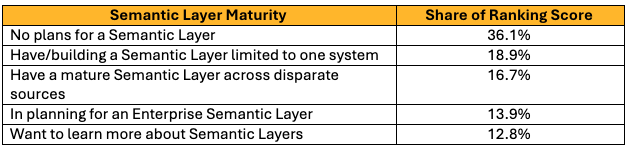
This presents an interesting contrast.
The audience clearly identified problems that Semantic Layers are intended to address—particularly the need for meaningful, well-defined and accessible data—yet relatively few organizations appear to have reached a mature enterprise implementation.
That suggests the barrier isn’t necessarily recognizing the problem. The harder question is how to get started.
Don’t start by trying to model the entire enterprise
One of the key recommendations from the presentation was to resist the temptation to build everything at once.
Large enterprises can have tens of thousands of data elements spread across hundreds of databases. A practical Semantic Layer initiative should therefore begin with a high-value, low-to-medium-complexity business use case that can demonstrate tangible value and build organizational support.
Just as importantly, organizations shouldn’t start with the technology. They should start with the business.
Before designing the Semantic Layer, organizations need agreement on terminology, relationships, business rules, and data-quality rules. The presentation recommends developing a Business Concept Model first—identifying concepts such as Customer, Product, Sale, and Store and defining how those concepts relate to one another.
That business model can then become the foundation for the Semantic Layer.
A Business Glossary is equally important. Terms, definitions, related concepts, stewardship, security constraints, and metrics need to be explicitly documented rather than residing in spreadsheets—or worse, in people’s memories.
Semantic Layers may become even more important in the age of AI
The audience results raise a larger question.
For years, organizations have struggled to make enterprise data easier for humans to find and understand. Now we’re asking AI to find, interpret, combine, and reason over that same data.
That doesn’t eliminate the semantics problem. It magnifies it.
A Semantic Layer, supported by a Business Glossary and Data Catalog, data governance &stewardship, and carefully designed data models, can provide both people and AI with a more consistent understanding of enterprise information.
The ultimate goal is straightforward: business users should have timely access to meaningful, intuitive, easy-to-use, high-quality data without needing to understand all of the technical complexity underneath it.
The ISACA Phoenix survey suggests that many organizations recognize the need—but most are still somewhere on the journey.
And that leads to several questions worth exploring further: How should an organization build its first Semantic Layer? What role should the Business Concept Model and Business Glossary and Data Catalog play? Which technologies are appropriate? Do you still need a data warehouse or data lake? And perhaps most importantly today, how can a Semantic Layer provide trusted business context to generative AI? A highly experienced data architect who can bridge the business and technical worlds needs to design the Semantic Layer – please let me know if I and my team can be of assistance in building your Enterprise Semantic Layer!
Those are subjects I’ll explore in future articles.

Pete Stiglich: Trusted Expert in Data Architecture & Modeling
Pete has over 30 years of data architecture, data management, and analytics experience, most of that time as a consultant in industries such as government, finance, healthcare, insurance, and more. He is an industry thought leader in data architecture and data modeling and has developed and taught many courses on these topics. Pete enjoys helping clients solve complex data problems, leveraging proven approaches such as “Modeling the business before modeling the solution” which provides a benefit to clients that many IT professionals miss.
Join Our Data Community
At Data Principles, we believe in making data powerful and accessible. Get monthly insights, practical advice, and company updates delivered straight to your inbox. Subscribe and be part of the journey!