By W H Inmon
With ChatGPT and Generative AI comes the LLM – large language model. The LLM contains, among other things, a vocabulary that is needed to direct the attention of the Generative AI processor to the documents that are processed. The LLM helps Generative AI to find and interpret the raw text that is being read.
The assumption of ChatGPT is that it can read and interpret language coming from anywhere. By extension, the implication is that the LLM that supports ChatGPT contains every word that is needed to understand a document or a conversation. The implication is that the LLM that services ChatGPT for the processing of general conversation encompasses the vocabulary of everything.
There is, however, an evolution that is occurring. For a number of important reasons, the LLM is evolving to a language model that can be called the BLM – business language model.
There are a lot of reasons for this evolution from the LLM to the BLM.
TOO MANY WORDS / TOO COMPLEX
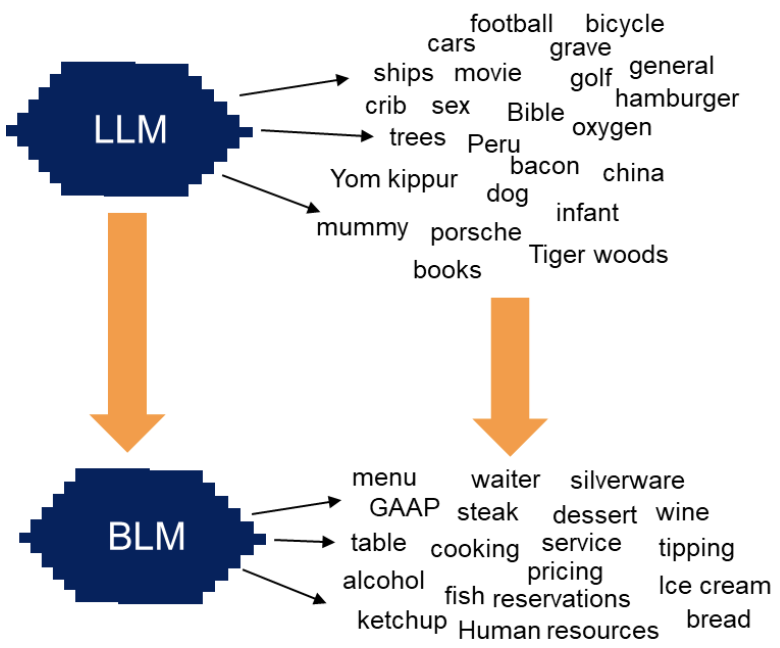
The primary and most basic reason for the evolution is that a true vocabulary and interpretation of every word known to man is an impossible task to build and an equally impossible task to maintain. There are simply too many words, too many interpretations, and too many complexities in sorting out vocabulary to actually build a true LLM that looks at language on a generality basis.
Instead, for a variety of reasons, the world of analytics is evolving to BLMs, not LLMs.
LLM VOCABULARY
So what does the vocabulary of the LLM look like? In its theoretical final form, the LLM contains all words and how they should be interpreted. Of course, there are a lot of words, and an even greater number of ways those words can be interpreted.
The simplest way to describe the complexities that arise in interpreting language is to understand that much of language understanding depends on the context of the words surrounding the vocabulary.
For example, two men are standing on a street corner and a young lady passes by. One of the gentlemen says – “She’s hot.”
Now, what is meant by the words – “she’s hot?”
One interpretation is that the lady is attractive and the man would like to have a date with the lady.
Another interpretation is that the corner is in Houston, Texas, on a July day. The temperature is 98 degrees, and the humidity is 100%. The lady is sweating profusely. She is physically hot.
Another interpretation is that the two men are doctors. The lady is a patient and has a temperature of 104 degrees. Internally, she is hot.
So it is not just the vocabulary that matters, but the context that matters as much as the word itself. If LLMs were as simple as merely capturing and defining a vocabulary, LLMs would not be so difficult.
And there are plenty of other complexities that arise when looking at an LLM.
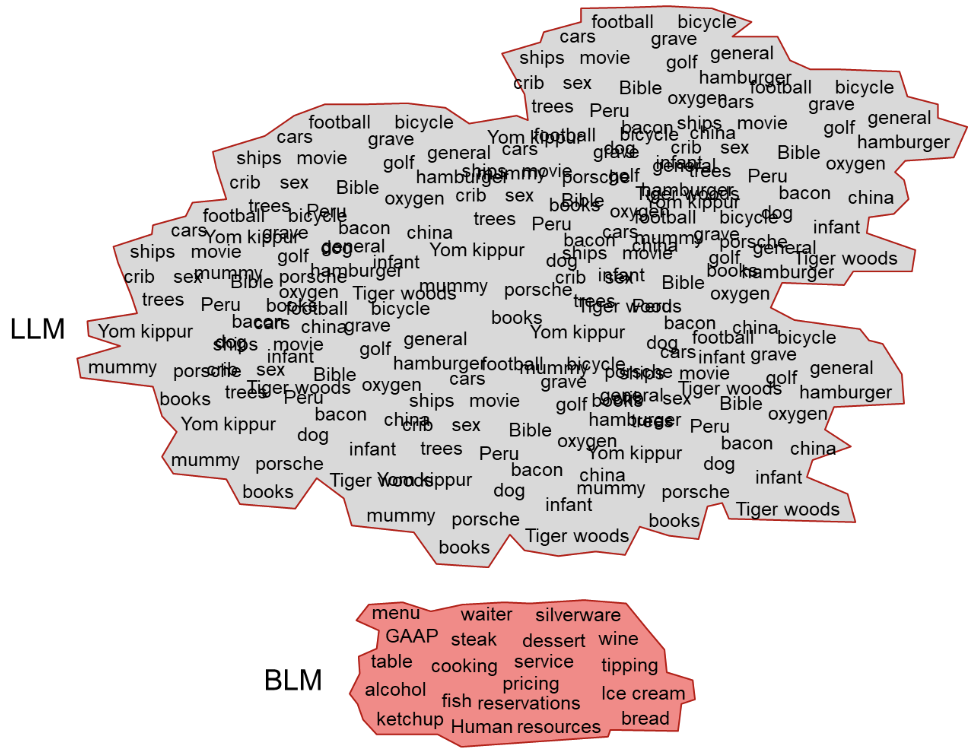
The BLM contains, on the other hand, only those words significant to a single business endeavor. Unlike the LLM, the BLM is focused. The business endeavor found in the BLM may encompass such things as –
- Medicine
- Legal
- Banks
- Telecommunications
- Railways
- And so forth.
The vocabularies from the two kinds of models are shown –
SHEER SIZE
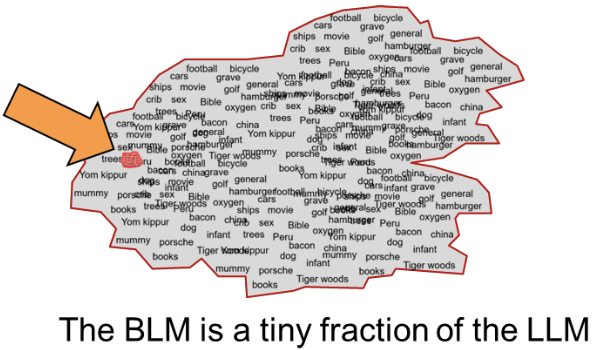
While there are many differences in the content and the structure of the two types of language models, the single largest difference is in the sheer size of the models.
The following figure shows that the BLM is a tiny fraction of the size of the LLM.
BUSINESS VALUE
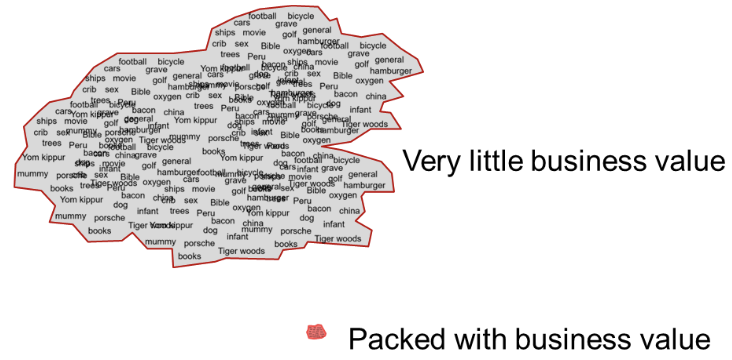
Another major difference in the two models is the difference in the business value addressed by the two models.
The LLM contains huge amounts of vocabulary that have little or no business value. Organizations find that trying to create an LLM that contains very limited business value is a waste of time and money.
On the other hand, the vocabulary found in a BLM contains a potent amount of business value.
Conclusion
It is because of the sheer size and complexity of the LLM and the fact that the vast majority of the LLM does not contain business value that the evolution from an LLM to a BLM is occurring.

Notable Works by William H. Inmon, Pioneer in Data Architecture
You may like Bill’s latest book –
STONE TO SILICON: THE HISTORY OF TECHNOLOGY AND THE COMPUTER INDUSTRY, by Dr Roger Whatley and Bill Inmon, Technics Publications.
Available on Amazon and Technics Publications.
Join Our Data Community
At Data Principles, we believe in making data powerful and accessible. Get monthly insights, practical advice, and company updates delivered straight to your inbox. Subscribe and be part of the journey!