By W H Inmon
Lately, people have been claiming that a data warehouse is of necessity centralized in a single location or on a single complex of machines. In practice, many data warehouses are built this way. But does it have to be this way? Are data warehouses essentially centralized structures?
Consider the definition of a data warehouse –
A data warehouse is a
- Subject oriented
- Integrated
- Non-volatile
- Time variant
collection of data in support of management’s decisions.
This definition of a data warehouse has been around since the very beginning of data warehousing and is used by practitioners everywhere.
Exactly where in the definition of a data warehouse does it say that a data warehouse has to be centralized to a single platform or a single location?
The answer is that there is nothing in the definition of a data warehouse that says it must be centralized. Or decentralized. The definition of a data warehouse says absolutely nothing about the implementation of the data warehouse.
Historically, data warehouses arose in the day and age of the mainframe computer. In that day and age, most data bases were indeed centralized. It is only natural that early data warehouses built on mainframes were centralized, as were nearly all other data bases that were built then.
The definition of a data warehouse speaks to the integrity and structure of the data, not the implementation.
One could imagine a data warehouse where sales data resided in Oregon, manufacturing data resides in Ohio, finance data resides in Florida, and administrative data resides in Texas. Collectively, all the data form a data warehouse. But the data is anything but centralized.
What matters is that data – once the data is being used for decision making purposes – is believable. There better not be two or more versions of the same data anywhere. There better not be a corporate version of the data, a Virginia version of the same data and a Canadian version of the same data. Virginia and Canada are welcome to have their own data, but that same data cannot be found elsewhere in the corporation.
The believability of the data relies on the data being –
- Complete
- Accurate
- Up to the second
- Integrated across the corporation
- Granular, supporting different interpretations of the data
- Singular, where data resides in only one place in the corporation
The data in the corporate data warehouse can be implemented either centrally or in a decentralized manner. But wherever the data resides, the data needs to be believable.
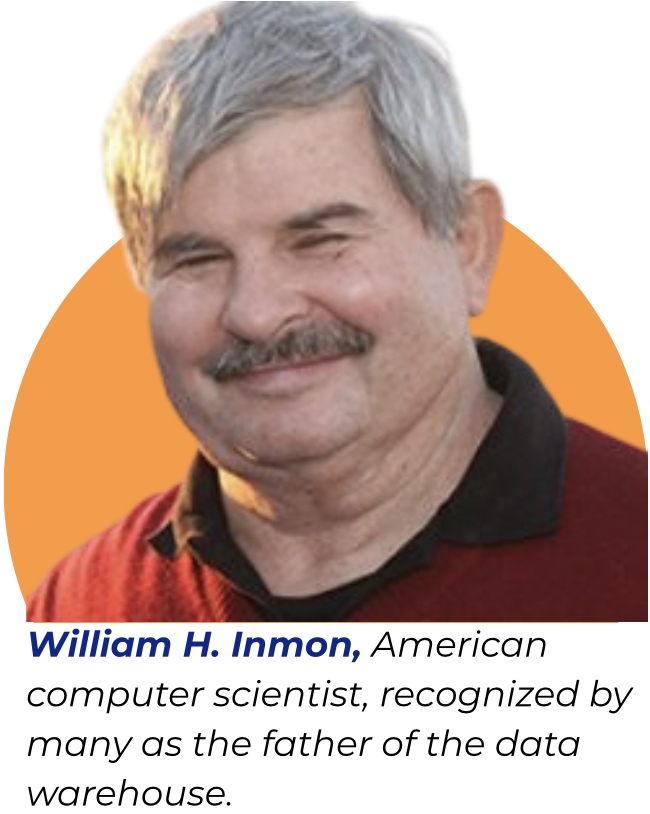
Notable Works by William H. Inmon, Pioneer in Data Architecture
Bill Inmon lives in Denver with his wife and his two Scotty dogs – Lena and Rollie. It is summer and Lena and Rollie delight in playing in the back yard. Lena has found a path into the tomatoes but she hasn’t shown the path to Rollie yet. It is Lena’s secret.
Bill Inmon wrote the book HEARING THE VOICE OF THE CUSTOMER and TURNING TEXT INTO GOLD for Technics Publications. Bill’s latest book is MODERNIZING MEDICAL RESEARCH: AI AND MEDICAL RECORDS, Technics Publications.
Join Our Data Community
At Data Principles, we believe in making data powerful and accessible. Get monthly insights, practical advice, and company updates delivered straight to your inbox. Subscribe and be part of the journey!