By By W H Inmon
Classical data architecture is dominated by structured data. Structured data was the first type of data that people had to deal with, so it is natural that their explorations and observations centered on structured data.
But as time passed, new types of data entered into the equation. The world woke up one day, and there was textual data, structured data, and analog data.
Textual data came in many forms – emails, conversations, the Internet, spreadsheets, and so forth. Analog data too sprang up from many sources – telemetry equipment, thermometers, drones, and so forth.
Soon, the world of data was inundated with all kinds of data, of which structured data was only one type.
At first the technicians of the world tried to ignore the non-structured data. But over time, it was realized that a mature data architect had to
account for ALL the kinds of data that existed.
The reaction the data community had was to treat textual and analog data with the same tools and techniques that had been learned in the day and age of structured data.
The problem was that textual and analog data had very, very different properties and characteristics than structured data. Trying to manage textual and analog data as if it were structured was like trying to pull a moving van with a child’s tricycle.
The match was simply inappropriate and was and is doomed to failure.
The properties of structured, textual and analog data are extremely different. The two most illustrative ways in which the differences in the properties of these types of data show up is in terms of:
- The sheer volumes of data.
- The percentage of the data that has business value.
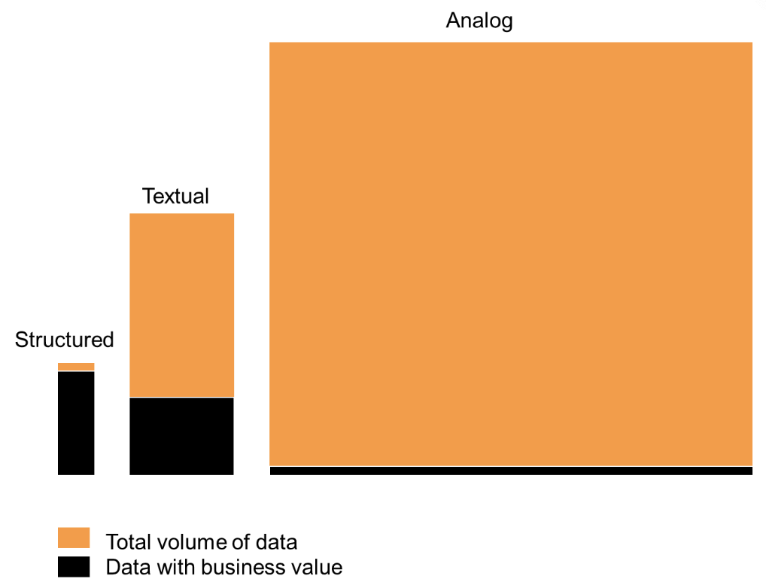
The diagram shows that there is a lot more textual data in the corporation than structured data in the corporation and that there is even more analog data than there is textual data. These differences are reflected by the orange boxes in the diagram.
The percentage of data that has business value is shown by the black portion of the boxes.
Nearly all structured data has business value. Some structured data has a great amount of business value. Some have less. But nearly all structured data has some degree of business value.
Textual data has a mixture of non business value data and some percentage of textual data has business value. When a guy sends an email to his girlfriend – “I’ll pick you up tonight at 8:00” there is no real business value here. And much of the text has no real business value. But some of the text has great business value. A customer says – “I did not like my steak last night.” The management of the restaurant needs to know.
Depending on the business, from 20% to 40% of text has business value.
Analog data is a different matter altogether. Only a small percentage of analog data has business value. In order to understand this, consider a security camera sitting on a pole looking at a corporate parking lot.
Day in, day out, the surveillance camera sits and observes the parking lot, taking individual snapshots at 1/30th of a second each hour of the day.
Day in, day out, cars enter the parking lot, depart the parking lot, and park. People get out of their cars and head for work. Month after month, the surveillance captures the comings and goings of the company’s workers. The snapshots taken during these times have little or no business value.
Then one day a car break-in occurs. In one short three minute time frame, a thief finds a car, breaks into it, and steals the contents of the car.
Of the months and months of snapshots taken, only a few seconds are of real business value and interest. On a percentage basis, the vast majority of the snapshots have no business value. But for those few moments when there is business value, the value to the business is extreme.
The very different properties of the types of data mandate that there be very different treatments of the data in the data architecture of the organization.
For a treatment of modern data architecture that understands the different types of data that need to be encompassed, take a look at the newly issued book DATA ARCHITECTURE: BUILDING THE FOUNDATION, Technics Publications.
Find out what a modern approach to data architecture looks like.

Notable Works by William H. Inmon, Pioneer in Data Architecture
Bill Inmon lives in Denver with his wife and his two Scotty dogs – Lena and Rollie. It is summer and Lena and Rollie delight in playing in the back yard. Lena has found a path into the tomatoes but she hasn’t shown the path to Rollie yet. It is Lena’s secret.
Bill Inmon wrote the book HEARING THE VOICE OF THE CUSTOMER and TURNING TEXT INTO GOLD for Technics Publications. Bill’s latest book is MODERNIZING MEDICAL RESEARCH: AI AND MEDICAL RECORDS, Technics Publications.
Join Our Data Community
At Data Principles, we believe in making data powerful and accessible. Get monthly insights, practical advice, and company updates delivered straight to your inbox. Subscribe and be part of the journey!