By Anne Marie Smith, Ph.D., CBIP, ARM, FIDM, FIIM
Enterprise Data Management facilitates the management of data as a valuable asset of an enterprise. Using an EDM framework can improve an organization’s capabilities to manage data as a resource.
Introduction
Although every organization collects, stores, and uses increasingly large amounts of data, many companies do not use a common framework for managing all the functions that make this data a true asset. Enterprise Data Management (EDM) is the global function that facilitates the management of data as a valuable asset of an enterprise. In general, EDM includes:
- Data Governance and Data Stewardship
Planning, oversight, and control over the management of data and the use of data and data-related resources; developing and implementing policies and decision rights over the use of data.
- Data Architecture and Data Modeling
The overall structure of data and data-related resources as an integral part of the enterprise architecture; developing and implementing models to support effective data management and usage.
- Data Operations
Deploying and managing storage and connectivity of structured physical data assets.
- Data Security
Ensuring privacy, confidentiality, and appropriate access to data based on policies, procedures, and regulations.
- Data Integration & Development
Acquiring, transforming, moving, and delivering data for operational support and to support decision-making efforts.
- Documents & Content Management
Storing, protecting, indexing, and enabling access to data found in unstructured sources (electronic files and physical records), and making this data available for integration and interoperability with structured (database) data.
- Reference & Master Data
Managing shared data to reduce redundancy and ensure better data quality through standardized definition and use of common data values.
- Data Warehousing & Business Intelligence
Managing analytical data processing and enabling access to decision support data for reporting and analysis.
- Metadata Management
Collecting, categorizing, maintaining, integrating, controlling, managing, and delivering the context of data (definitions, calculations, descriptions, sources, etc.)
- Data Quality
Defining, monitoring, maintaining data integrity, and improving accuracy, completeness, validity, timeliness, and consistency of data.
These aligned disciplines/functions of enterprise data management provide principles and practices for creating and using data and information as organizational resources. Without a framework for managing these functions cohesively, they will be forgotten or performed inconsistently – reducing the value of the data to increase revenue and reduce costs.
Benefits of Enterprise Data Management
Connecting the functions of enterprise data management can provide a variety of benefits to any organization, especially one that creates and consumes data as a major resource:
Improved access to organized, properly defined data through data governance and metadata management.
Improved quality of data for decision making and operations – faster operations and faster, more accurate decisions.

Confident access to sharable data where appropriate.
Improved reporting and analytic capabilities on both enterprise and local scales, for accurate results.

Improved data security and privacy access according to regulations, standards and procedures applied consistently.
Integration of data across sources according to standards and using a consistent architecture framework, for ease of integration and access.
Conclusion
Enterprise Data Management is an essential function of every organization, providing the structure and capabilities for managing data and information as assets. To realize the value of its data and information assets, every organization should learn how to develop and sustain an enterprise approach to data management and its core functions.
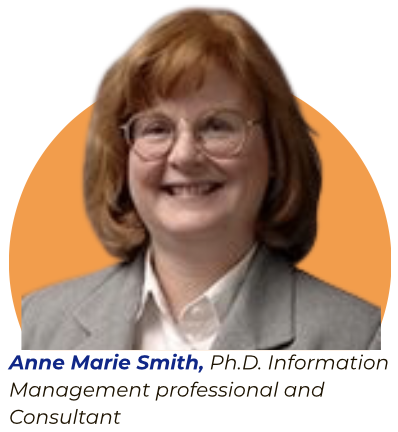
Dr. Anne Marie Smith: Architect of Modern Data Management Practices and Educator of the Profession
Anne Marie Smith, Ph.D. is an Information Management professional and consultant with broad experience across industries. She is a certified data management professional (CDMP), and is a frequent speaker and an author on data management topics. Anne Marie is a primary author of several sections of the DAMA-Data Management Body of Knowledge (DAMA-DMBOK). Anne Marie received the DAMA International Professional Achievement Award in 2015. She was awarded the designation of “Fellow of Insurance Data Management” and “Fellow of International Information Management” and holds numerous certifications.
Anne Marie’s consulting areas include: enterprise information management strategy and planning, enterprise information assessment and program development, data governance program development, data warehousing, business requirements gathering and analysis, master data management, data quality management, data architecture. She has taught numerous workshops and courses in her areas of expertise.
Anne Marie holds the degrees of Bachelor of Arts and Master’s of Business Administration in Management Information Systems (MIS) and Risk Management from La Salle University; she earned a Ph.D. in MIS at Northcentral University.
Join Our Data Community
At Data Principles, we believe in making data powerful and accessible. Get monthly insights, practical advice, and company updates delivered straight to your inbox. Subscribe and be part of the journey!